The Top 7 Challenges Facing Corporate L&D Teams in 2022
Of the 1,260 L&D professionals surveyed for LinkedIn’s 2021 Workplace Learning Report, 64 percent said that L&D shifted from a “nice to have” to an essential component of corporate success in 2021. While the pandemic played a large part in accelerating this shift, there are three underlying trends at play:
- Widespread use of automation and artificial intelligence (a.k.a. digital transformation) that’s replacing old jobs and creating new ones.
- Greater parity in use and access to technology and technical skills.
- A world population that is more connected than ever.
There’s no sign of these trends declining soon. Innovation will continue, but companies need the right people to harness it, use it to maximum effect, and push the company forward. The spotlight is on L&D teams to deliver, and companies who achieve key L&D objectives and goals will win in this decade.
Vital learning objectives for corporate L&D teams in the current climate include:
- Reacting quickly to industry or company changes. Companies worldwide saw the importance of agility in the face of change in 2020. The pace of innovation across industries and fields means an agile workforce is required for success.
- Providing development opportunities in a remote work model. With more employees working in remote or hybrid settings than ever before, L&D teams must provide engaging development opportunities to employees wherever they are working.
- Upskilling and reskilling. Retaining great talent is central to any L&D team’s purpose. This means that upskilling processes and programs must be established to hold on to good employees by leveling up and rounding out their skillsets.
- Improving critical soft skills. Soft skills aren’t “intangible;” they have real effects on the bottom line. Employees who collaborate, communicate, and solve problems at an elite level will drive companies forward and have the greatest impact. It is essential that L&D teams are able to assess and enhance soft skills across all parts of the organization.
- Improving learner engagement and satisfaction. The success of L&D initiatives can be traced back to how well they engage employees. Relevance and real-world application are two key stimuli L&D teams must incorporate into their initiatives. Otherwise, they risk wasting time and budget on L&D activities that don’t move the needle.
- Fitting effective development into the workday. Time is money, so your employees’ time shouldn’t be wasted on half-day or day-long seminars. L&D activities must fit into the workday while remaining impactful for workers.
- Creating a culture of infinite learning. The biggest impact L&D teams can have on their organization is creating a culture where everyone always wants to improve. L&D teams must create programs and frameworks that help employees -- from entry-level to the executive team -- feel like there’s always room to grow and improve.
Fortunately, there’s a scalable, cost-effective solution exists to tackle these issues: simulation-based training.
Simulations Have Specific Advantages over Traditional Training Methods
To be clear, we’re not saying simulations are the ONLY solution. But they have distinct advantages over other methods that make them a must-have for achieving objectives for learning and development.
Simulations include avenues for applying soft skills in a real-world situation.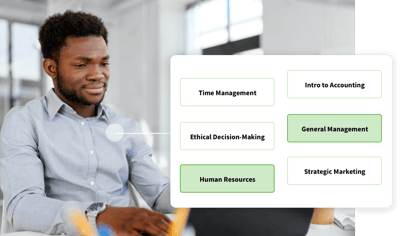
Athletes run through sets and reps of drills and weight training to give themselves the best chance of performing at a high level on game day. Developing soft skills requires the same approach.
Simulations put employees in situations they’ll face on the job, giving them the chance to learn in a risk-free environment. From communication and time management to leadership, problem-solving, and more, L&D teams can help employees hone their soft skills using simulations.
Simulations are engaging and relevant to your learners.
Effective development opportunities mirror real work situations and decision-making. The more relevant learning is to your employee’s actual jobs, the more engaging it is.
Engagement is also influenced by the instructional methods used. A half-day seminar may be highly relevant, but presentations and lectures can grow dull after 30 to 45 minutes.
Digital, story-based tools like inbox simulations place learners “into” the story, lighting up key sections of their brain and providing a channel for practical application.
Simulations help develop self-awareness of soft skill gaps. 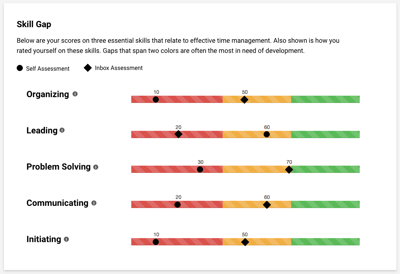
We’ve all known that one coworker or friend who overestimates their abilities. This particular bias is known as the Dunning-Kruger effect.
Traditionally, soft skills are measured by comparing employees’ self-assessments with their actual job performance. But if the skill assessment is incorrect from the start, how can you measure progress accurately? Moreover, how will your employees truly understand their weaknesses?
Simulation-based soft skill training programs include both employee self-assessments and objective assessments. The resulting report shows employees the gaps between the two, making them aware of their own abilities and skill gaps from the beginning.
Self-awareness is a crucial step in improving soft skills of employees to help them work smarter, collaborate better, and reach both L&D and organizational goals.
Simulations include channels for immediate, actionable feedback. 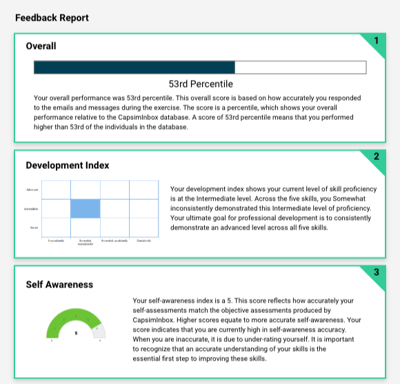
In lectures and presentations, there is no chance for feedback because communication is mostly one way. Some assessments provide feedback, but if it takes days or weeks to get those results, your employees have already forgotten the bulk of the material covered by the time they receive that feedback.
Immediacy and quality of feedback is crucial to the effectiveness of L&D activities and achieving objectives for learning and development. It needs to happen directly after the training activity and needs to be more in-depth than right-wrong or yes-no.
Digital simulations collect and present session data to the employee when they complete their learning module. Plus, L&D staff see results and can use the session data and progress tracking to inform their debriefing and feedback activities.
Simulations are an “all-in-one tool”
With most L&D solutions, you have separate platforms for every part of the process. Siloed tools are problematic for a few reasons.
First is the cost of relying on multiple tools with very specific use cases. L&D team members must be onboarded onto and learn each platform. Plus, you have to manage each platform. The more users you add, the more bloated and unmanageable your L&D tech stack becomes.
On the flip side, simulations have everything L&D teams need to achieve their objectives. From assessments and pre-built training modules to skills gaps analyses, progress tracking, and build-your-own-simulation capabilities, simulation platforms decrease the need for using multiple tools with super-specific use cases.
Assessing Skills Gaps
In February 2020, McKinsey published a survey of executives and managers and their views and approach to changing workplace skills. More specifically, the survey looked at how companies were addressing skill gaps and skill shortages.
Eighty-seven percent believed there were existing skill gaps in their workplace or expected skill gaps to appear within the next five years. Ideally, companies are identifying skill gaps before the consequences begin to show up in company performance.
You can identify these skills gaps using our five-step process for performing a successful skills gap analysis:
- Review your company’s objectives, goals, and future initiatives.
- Identify “future of work” trends that will impact your people and your company.
- Make a comprehensive list of skills required to keep up with trends and help your company meet L&D and organizational goals.
- Assess your employees’ current skills.
- Use your assessment data to identify gaps in current skills and competencies versus desired skills and competencies.
Assessing skills and identifying skills gaps for key employees is the first step in creating a resilient and fine-tuned workforce.
But most assessment tools are generic and irrelevant to specific roles and skills. For an accurate evaluation, assessments should mirror the real-world environment, be relevant to the learner's role, and evaluate specific skills at the task level.
You can use CapsimInbox or Capsim’s assessments to proactively identify skill gaps before they cause problems.
Capsim’s skill assessments begin with a self-assessment. Next, we objectively measure skills through simulations that put your employees in a real-world scenario. You get a baseline for their skills and can identify gaps between perceived and actual competency.
Increasing Knowledge Retention and Transfer of Training
Humans are really good at forgetting things. If you’ve ever forgotten where you’ve left your car keys or the name of that couple you were introduced to just moments ago, you know this to be true. But it’s especially true when it comes to learning and development.
In the late 1800s, German psychologist Hermann Ebbinghaus found that humans tend to forget new information if we don’t apply the new concepts in a real-world setting. After 20 minutes, we lose 42 percent of what we just learned. After one day, we only retain 34 percent of new information.
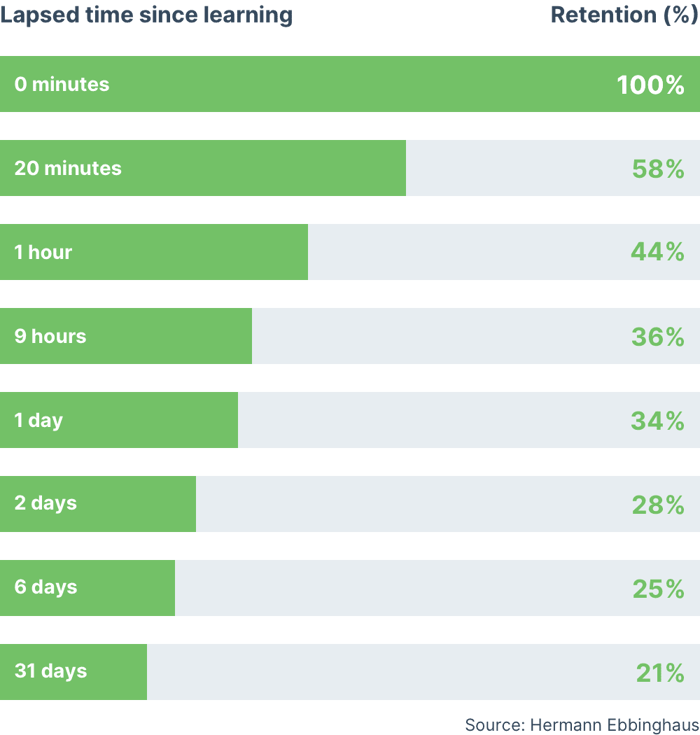
This lack of “learning reinforcement” is the Achilles heel of traditional instructional methods that focus on knowledge acquisition. Studies have shown that a only a very small portion of knowledge acquired (19 percent) can be skillfully applied.
In order to reinforce the knowledge gained from lectures and presentations, L&D teams need to use instructional methods that give employees the real-world “sets and reps” that lead to skill improvement.
An analogy that is helpful is comparing it to a scrimmage in sports. In daily practice, players learn the plays and run drills to refine technical abilities - but the scrimmage simulates the big game and gives them a chance to put it all together (while the coach observes and evaluates).
CapsimInbox helps corporate L&D teams maximize the stickiness of their training. Simulations enable your employees to apply knowledge in a controlled, risk-free setting that resembles their actual jobs.
Ready-to-use inbox simulations were built based on the experiences of top-level professionals in their given roles, making them incredibly relevant and engaging for your employees.
Upskilling & Reskilling Employees
The labor shortages of 2021 have persisted into 2022. These shortages mean that filling positions — especially high-skill jobs — is even more challenging than usual. That’s where upskilling and reskilling come in.
In an upskilling scenario, you help employees acquire new skills or level-up current ones to help them perform their current job more effectively. You should consider upskilling if you experience one or more of the following:
- Poor skills gap analysis results
- Poor or worsening performance
- New technology implementation
- Changes to organizational structure
Reskilling is the process of helping employees develop new skills they need to take on a new job role in your company. You should consider reskilling if you have employees who:
- Have skills that overlap with the skills needed for the new position.
- Are high performers and possess a desire to take initiative.
- Aren’t performing up to par in their current job, but have an impeccable attitude and skills that align with the new role.
- Have expressed interest in reskilling.
Digital assessments and inbox simulations (like CapsimInbox) provide the baseline skill data you need by assessing current employee skill levels and identifying skill gaps. They can also shed light on weaknesses employees didn’t know they had, creating self-awareness of skill gaps.
CapsimInbox is also ideal for giving micro-doses of hard- and soft-skill learning through ready-to-use or custom-built inbox simulations. And underneath it all, reporting, analytics, and progress measurement keep learners engaged and executive teams apprised of your employees’ development.
Related Reading: How to Upskill Your Workforce in 2022: A Step-by-Step Approach
Developing Soft Skills and Emotional Intelligence
A 2021 America Succeeds analysis showed the top five soft skills were requested nearly four times more than the top five hard skills across 82 million job postings.
Helping your employees develop key soft skills like those listed below will enable you to make people your competitive advantage in the marketplace:
- Communication
- Problem-solving
- Decision-making
- Conflict resolution
- Adaptability
- Critical thinking
- Time management
While related to soft skills, emotional intelligence is slightly different, but no less vital for employees to work at the highest level. Emotional intelligence, or EQ, is the ability to perceive, reason, understand and manage emotions.
People with high EQ:
- Make better decisions
- Keep cool under pressure
- Resolve conflicts
- Have greater empathy
- Listen, reflect, and respond to criticism
In short, cultivating soft skills and developing emotional intelligence not only helps employees grow, but primes them to become the “A+” players who will help you achieve objectives for learning and development.
“But how do you develop soft skills and emotional intelligence? Isn’t it really hard to do?”
It’s true. Soft skills and EQ have traditionally been labeled as “hard to train.” But that’s only because the traditional training methods for soft skills and EQ don’t align with how those skills show up in real life.
Soft skills and EQ aren’t something that can be effectively presented via PowerPoint. These skills are all about how an employee reacts to real-world situations. If your training provides employees the opportunity to practice new soft skills in a real-world situation, they have a higher chance of succeeding in picking up these skills.
That’s where CapsimInbox excels as a soft skills and EQ training tool over traditional methods. In as little as 10-15 minutes, your employees can face a day’s worth of scenarios and decisions for their specific role. They also get immediate, actionable feedback to help transfer what they’ve learned to their job.
Fortifying Your Succession Planning
Who are the future leaders of your company? You need to have a pipeline of quality people capable of sliding up into manager and director level positions to keep your company on course for success.
What does this mean for L&D teams? You must be assessing the tangible and intangible leadership qualities of your employees so you can spot emerging leaders.
In the past, most companies have attempted to create a leadership pipeline simply by reviewing job performance and through the course of annual reviews. This method has a few inherent problems:
- Annual reviews are often skewed because of recency bias; they become too focused on what an employee has done in the last two to three months.
- Annual reviews are also not objective, and can be riddled with personal biases.
- “Leadership material” too often is applied to personal qualities incorrectly affiliated with good leadership: “type A” workers who are extroverted order-givers.
- Thus, people who may be great leaders are overlooked for personal favorites and those fitting the outdated view of a good leader.
The future leadership of your company is too important to leave to biased, subjective decisions. Digital assessments and inbox simulations help L&D teams with succession planning in a number of ways.
As we’ve mentioned, digital assessments and inbox simulations are adept at assessing current leadership skills, soft skills, and emotional intelligence. You can compare the resulting data against a self-assessment to highlight skill gaps and provide self-awareness of these gaps to your employees.
Providing Development Opportunities in a Hybrid or Remote Workforce

Forbes estimates that by 2025, 70 percent of the workforce will be at least partially remote. As a result of pandemic, more people are working remotely or in hybrid situations than ever.
While this is beneficial for employees who work better in remote or hybrid setups, a remote workforce introduces a few additional obstacles for L&D teams dependent on traditional instructional methods.
First, having employees spread across various locations limits access to certain training tools and techniques. Accompanying materials like binders, worksheets, and guides must either be shipped or sent to employees for them to print on their own.
Even employee-preferred training methods like on-the-job (OTJ) training become challenging in remote or hybrid work situations. How do you complete OTJ training with a distributed workforce? Pursuing this method can become a logistical nightmare, coordinating travel, blocking off calendars, and trying to cram as much training as possible into a short amount of time.
For L&D teams to achieve key objectives, it’s crucial to provide development opportunities to all employees regardless of where they work.
CapsimInbox simulations are delivered online “as a service.” The web-based nature of simulations means all your employees access to engaging and applicable development regardless of where they work. All they need is an internet connection.
Retaining Top Talent
A 2019 report from DDI’s Frontline Leader Project showed that fifty-seven percent of employees who quit report their manager as their chief reason for quitting. Additionally, a 2019 LinkedIn study found that 94 percent of employees would feel inclined to stay with their current employers if they were given relevant professional growth opportunities.
In the spring of 2021, we saw the start of a workplace phenomenon some experts call “The Great Resignation.” Employees began leaving their jobs in droves, leaving many companies understaffed.
Learning and development plays a giant role in retaining top talent by offering development and growth opportunities that can lead to promotions. LinkedIn’s 2021 Workplace Learning Report found that employees at companies with internal mobility stay almost two times longer (5.4 years vs. 2.9 years).
So what can L&D teams do to retain top talent to achieve key objectives? Create individual development plans customized to each employee. Aside from the obvious benefits of developing your team members, individualized development plans show that you’re invested in your employees’ future, making them more likely to stay.
Use CapsimInbox to Achieve Your L&D Objectives
A landmark study from 2011 demonstrated the benefits of simulation-based learning. Participants in the study:
- Increased self-efficacy by 20 percent
- Increased knowledge acquisition by 11 percent
- Increased knowledge application by 14 percent
- And increased knowledge retention by 9 percent
Traditional, knowledge acquisition-focused training and instructional methods alone won’t help you gain and maintain a competitive edge with your people.
The stakes and expectations are too high for L&D leaders and their initiatives:
- 81 percent of executives say talent is the number one priority at the company
- 90 percent say that L&D is a necessary benefit to the employees at the company.
Winning in the decade ahead is reserved for companies who maximize the impact of their people. CapsimInbox was built for this moment.
From skills gap analyses and upskilling to onboarding, succession planning, and leadership training, CapsimInbox is your all-in-one tool for achieving your learning and development objectives.
We can prove it to you in two simple steps:
- Take a 5-minute self-guided demo of CapsimInbox to see exactly what your employees would see.
- Then, if you feel like CapsimInbox could be a valuable tool for your L&D team, get a more detailed product demo and access to a pilot account.
Bring knowledge and concepts to life in a real-world context. Give your employees the sets and reps they need to develop game-changing skills.