
Guide
What is a business simulation?
A business simulation is a hands-on learning activity in which participants run a modeled business. They make decisions, see what happens, and adjust what they do next, often over several rounds. Their choices change the situation they start the next round in.
In one popular kind, called a total enterprise simulation, participants run a whole company, deciding on pricing, production, R&D, marketing and finance. Several companies often compete in the same market, so one team's choices change another's results.
Business schools use simulations in strategy and capstone courses. Companies use them in leadership development. In both, people practice making business decisions in situations where knowing the concepts isn't enough.
How it works
How a business simulation works
Simulations built on a market model typically follow a repeating loop: decide, see the results, adjust. Each pass through it is called a round. Simulations built as branching stories work differently; see Types.
In a total enterprise simulation, where a round usually stands for a year, the loop looks like this:
- 1
Participants decide
Price, how much to produce, whether to build capacity, what to spend on R&D and marketing, how to finance it all.
- 2
The market responds
A model of customers and competitors turns those decisions into demand. There's no answer key; a price that works depends on what competitors charged.
- 3
The results post
Revenue, profit, market share, cash, stock price.
- 4
It carries forward
The plant they built and the debt they took on are where they start the next round.
↻Debrief, then back to step 1, from the position step 4 left them in. A choice in Round 2 is still shaping the options in Round 6.
That last step is what separates a simulation from a quiz. A quiz resets after every question. A multi-round simulation doesn't, so a choice in Round 2 is still shaping the options in Round 6.
Between rounds, many facilitated simulations include a debrief. It's where participants make sense of what happened: what drove the result, what they misunderstood, and what they'll change next.
Faculty will recognize the loop as the experiential learning cycle: act, see the result, make sense of it, try again.

In a typical Capsim course, teams play a few practice rounds, then six to eight rounds that count, usually about one a week across the term. A corporate program typically runs it in two or three days, though programs range from a single day to sessions spread over months.
Why they work
Why business simulations work for teaching strategy
Different simulation designs suit different goals. Total enterprise simulations are especially useful for strategy, because strategy is a whole-business problem.
Business is usually studied one function at a time: a marketing course, a finance course, an operations course. Running a company doesn't work that way. A price cut is a marketing decision that becomes a production problem and then a cash problem.
A total enterprise simulation puts learners inside that whole system and creates three conditions that are difficult to reproduce in a lecture or exam:
- Condition 01There's no right answer.
Information is incomplete, competitors' moves are hidden until the results post, and the tradeoffs don't resolve cleanly. Participants have to decide anyway.
- Condition 02Every decision is felt across the business.
No lever moves alone. Cutting price raises demand, which strains capacity, which needs financing.
- Condition 03Decisions compound.
There's no reset. A plant built in Round 2 is still on the books in Round 8, and so is the debt that paid for it.
Faculty have a name for the problem this addresses: the knowing-doing gap. Students can define a strategy without being able to run one.
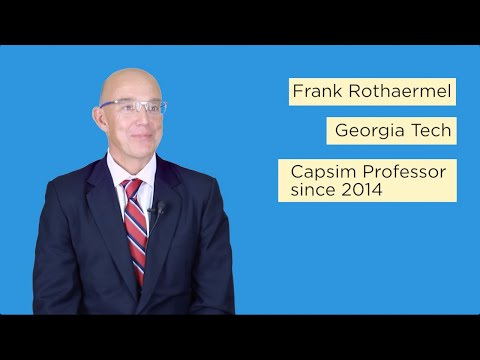
The biggest problem I had was the knowing and doing gap. The students knew about strategy, they knew the concepts, but they didn't do strategy. The Capstone simulation really allowed me to close the gap between knowing and doing.
Frank Rothaermel, Professor of Strategy, Georgia Tech
This is the first class where there's no single right answer. There's no multiple choice.
Justin Carter, University of North Alabama
Every generation of tools makes knowledge easier to get. None of them has made it easier to practice deciding when the answer isn't knowable in advance.
Compared
Business simulation vs. case study vs. game
| Dimension | Case study | Learning business simulation | Commercial management or tycoon game |
|---|---|---|---|
| What you do | Analyze a bounded situation and recommend a decision | Decide repeatedly and live with the modeled consequences | Build a business for fun |
| Consequences | Discussed | Modeled through calculated results, branching scenarios or both | Calculated, often forgiving |
| Competition | Described | May involve other participants, computer-run competitors or none at all | Usually the computer |
| Built for | Analysis and discussion | Specific learning outcomes, with reflection and assessment | Entertainment |
Case studies and simulations do different jobs, and they work well together.
An example
Business simulation example: one class, eight rounds
In spring 2026, a strategic management class ran Capstone: six teams, each running an identical company, over eight rounds. Every team's stock started at $34.25.
| Team | Start | R1 | R2 | R3 | R4 | R5 | R6 | R7 | R8 |
|---|---|---|---|---|---|---|---|---|---|
| Andrews | $34.25 | $51.76 | $59.80 | $76.02 | $78.76 | $42.86 | $1.00 | $2.29 | $41.24 |
| Baldwin | $34.25 | $36.91 | $44.33 | $67.86 | $101.70 | $138.22 | $194.68 | $263.29 | $349.43 |
| Chester | $34.25 | $51.19 | $55.69 | $58.97 | $64.28 | $1.00 | $1.00 | $1.00 | $1.00 |
| Digby | $34.25 | $42.53 | $53.29 | $74.60 | $46.72 | $57.08 | $69.70 | $107.51 | $203.95 |
| Erie | $34.25 | $21.82 | $10.25 | $22.72 | $55.97 | $104.41 | $151.95 | $242.75 | $335.97 |
| Ferris | $34.25 | $14.43 | $11.56 | $12.13 | $1.00 | $1.00 | $1.00 | $1.00 | $1.00 |
Same start, opposite paths. By the close, stock prices ran from $349.43 to $1.00.
- Baldwin finished first, with $313.95 million in cumulative profit and the biggest single round any team posted: $94.7 million in Round 8.
- Erie fell to $10.25 a share by Round 2, the lowest in the class, after back-to-back losses. It climbed every round after that and closed at $335.97, with the highest final-round margin in the class (57.38%).
- Two teams closed at the $1.00 floor.
Erie and Chester both hit trouble early. Chester sat second on stock after Round 1; Erie was at the bottom by Round 2. Erie finished second, and Chester finished at the floor.
What did Erie do in Rounds 3 and 4 that Chester couldn't, and was the difference how fast it responded or which way it went?
Erie ended with the higher margin, but Baldwin built far more profit along the way, $313.95 million to Erie's $233.18 million.
Is being the most efficient at the end the same achievement as compounding earlier and harder? The data alone can't settle it. The debrief is where the class works it out.
Types
Types of business simulations
There isn't one agreed list of business simulation types. A more useful way to compare them is across a few dimensions, where any one simulation sits somewhere on each.
Where Capsim's simulations sit on each spectrum
marks a Capsim simulation or format, plotted on the line.
Tournament = teams in a shared market. Footrace = individuals, each in their own market.
Participants run the whole company
Participants go deep on one area, such as marketing or supply chain
Participant-run companies compete for the same customers, so one team's price changes another's demand
Each participant or team plays in its own modeled market, often against computer-run companies
A group runs one company together
Each person runs a company alone
A made-up product in a made-up market
A bank, hospital or hotel
A market model calculates results
A story that branches on each choice
Software-based
Board-based
Scope, market interaction, participants and industry follow an academic classification of business simulations (Biggs, 1990). Model and medium reflect how simulations are designed and delivered today.
Neither column is the better one. The right design depends on the job. Capsim's own simulations show how one engine can sit at different points:
- Market interaction and participants. Most programs run as a tournament: teams share one market and compete with each other. The same simulation also runs as a footrace: each person plays in their own market against computer-run companies. That's how the Capsim Challenge runs more than a thousand entries on equal terms.
- Industry. The standard simulations are generic: every team runs an identical company making a deliberately ordinary product, sensors, so attention stays on the decisions. Custom programs for companies can be built around the company's own industry.
- Model. Capsim's business simulations are numeric and total enterprise. Its inbox simulations are the scenario kind: one person, one role, a realistic inbox of competing demands.
A note on realism, even in industry-specific simulations. More realism isn't always better. When a simulation copies a company's business too closely, people start arguing with the details instead of making decisions. Good custom simulations aim for relevance: the decisions feel like the learner's own, and the model stays simple enough to focus on them.
If you get too close, learners start to poke holes in it.
Matt Shell, Capsim
Examples
Examples of business simulations
-
The Beer GameMIT Sloan, 1960s
Each player runs one stage of a beer supply chain, ordering without seeing the rest of the chain, and watches small changes in demand grow into shortages and gluts.
-
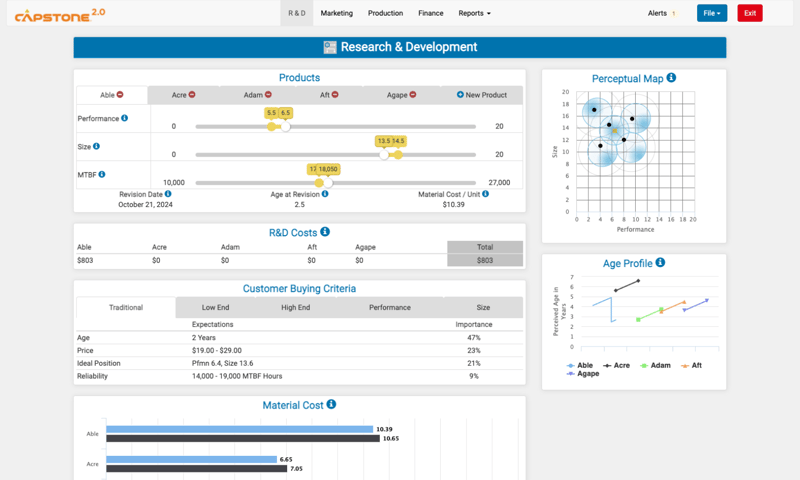 CapstoneCapsim's total enterprise strategy simulation
Teams each run a whole company for up to eight rounds, competing across five market segments.
-
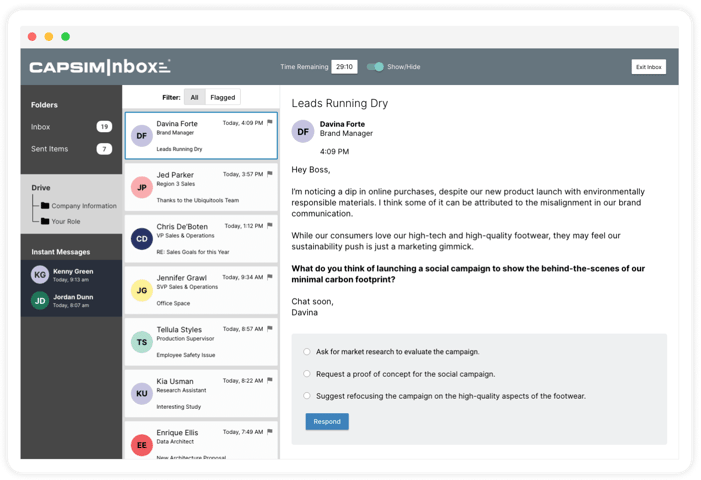 CapsimInboxCapsim's inbox simulation
One person, in one role, works through a realistic inbox of competing demands from colleagues, the board and customers.
Terminology
Business simulation vs. business simulation game
The terms are often used interchangeably. In business education and training, "business simulation," "business simulation game" and "business game" usually refer to the same thing. The more useful distinction is between learning simulations, designed around specific learning outcomes and reflection, and commercial management or tycoon games (titles like Railroad Tycoon or Sim Companies), built mainly for entertainment.
The research
Do business simulations work?
Yes, and the research is specific about when. Two large meta-analyses point the same way.
The first covered 65 samples and 6,476 adult learners, mostly college students trained on job-relevant skills. Learners taught with computer-based simulation games scored higher than a comparison group on:
- 20%higher self-efficacy
- 14%higher procedural knowledge
- 11%higher declarative knowledge
- 9%higher retention
Sitzmann (2011), a meta-analysis of 65 samples, 6,476 learners. Full citation in Sources.
The second, a meta-analysis of 145 studies of simulation-based learning in higher education, found large positive effects across fields including medicine, teacher education and management.
What makes the difference. In both analyses the gains depend on how the simulation is used. The advantage was largest when it supplemented other instruction, when learners were actively engaged, when they could replay it, and when reflection or guidance was built in, matched to what learners already knew: worked examples for novices, reflection for experienced learners. Used alone, or set against instruction that was just as active, simulations did no better. The conditions are the design of a good program, not a caveat about the tool.
Measure it directly. Reviews of business-simulation research note that the field leans on what students and instructors report learning. Good programs measure what people can do instead of how it felt.
A chart to be suspicious of. You may have seen the "learning pyramid" claiming people remember 10% of what they read and 75% or 90% of what they do. Those percentages have no research behind them. The case for simulations doesn't need them.
What we see at Capsim. Measured outcomes come from assessment, not from the simulation score. The business simulation scores the company: profit, market share, a balanced scorecard. Measuring what a person can do takes a separate assessment built for it, such as Comp-XM, which draws its questions from each student's own simulation. Accreditors recognize simulations too: AACSB's newly ratified 2026 standards name simulations among the examples schools can use to show curriculum innovation and learners' ability to apply technology responsibly.
Fit
When a business simulation is the wrong tool
A simulation is a good fit when the goal is practicing decisions and living with their consequences. It's a poor fit, or needs help, in these cases:
- You're mainly introducing foundational content.
Simulations are strongest when participants know enough to make meaningful decisions. If the concepts are entirely new, give people some grounding first or build instruction into the experience.
- It's a one-off event with nothing around it.
A single workshop can open minds, but the experience matters more when it connects to the learner's real work before and after.
My advice is to focus on the bookends. The simulation is excellent, but it's most powerful when you clearly connect it to your organizational context.Jeff Wiltrout, VP of Corporate Strategy, Cummins
- The grade rides on winning.
Students start out wanting to win, and a grade tied to rank rewards caution over learning. Some faculty grade on improvement instead.
Initially it's all about winning for the students rather than having a focus on learning. However, the way I score students is on the degree of learning taking place, the delta and improvement. And so the big aha effects came with students who perhaps didn't do as well in the simulation but learned a lot about how strategy is made and executed.Frank Rothaermel, Georgia Tech
- There's no reflection or feedback.
A result alone doesn't explain why it happened. Whether reflection comes from a facilitator, an instructor or the simulation itself, participants need a chance to make sense of the outcome and adjust.
- You want a single number to decide a promotion or a hire.
A simulation is evidence. It should inform a people decision, never make it on its own.
- You don't have time to run it well.
Whatever the setup takes, a facilitated, multi-round simulation still needs time for onboarding, practice rounds and debriefing.
Two settings
In a course vs. in a company
- Usually used in
- Strategy and capstone courses, intro business, operations, international business
- Format
- Often a term: practice rounds, then several competition rounds, about one a week
- Who runs it
- The instructor, with the vendor's support
- What's measured
- Usually graded company performance; some programs add a separate assessment of individual learning, for example for accreditation
- Customized?
- Usually off-the-shelf, though some providers let instructors configure the scenario. How Capsim works with faculty
- Usually used in
- Leadership development, high-potential and new-manager programs
- Format
- A one-day workshop, a two- or three-day program built on the simulation, or sessions spread over months
- Who runs it
- A facilitator, the vendor, or both together
- What's measured
- Often readiness, observed by leaders, sometimes with a pre/post assessment
- Customized?
- More common, especially for company-specific leadership programs. How Capsim runs it for companies
How far can a company customize a simulation?
Companies can customize a simulation a little or a lot. At Capsim it comes in three depths. Each one includes the one before it, but deeper isn't better; the right depth is whatever the program needs:
- ConditionsThe company stays the same; the world around it changes. A recession in Round 3, a tariff, a jump in interest rates. Every team gets hit the same way; what differs is what each had already committed to.
- DecisionsNew decisions the standard simulation doesn't have, built around what the company is working on. A digital transformation module, for example, adds three decisions: how far to move from foundation to advanced technology, how to balance IT standardization against local initiative, and how much to invest in workforce readiness and change. Each one moves results elsewhere in the company, such as administrative cost, productivity and turnover. Each costs something this year. Whether it pays off shows up later.
- IndustryThe whole world is rebuilt: the company's own industry, markets, products and language, on the same engine underneath.
| R&D cycle time | 0.5% |
| Labor cost | 0% |
| Administrative cost | 9.1% |
| Productivity index | 1.5% |
| Turnover rate | 5% |
| Inventory carrying cost | 4% |
| Production after adjustment | −2% |
| Total expenditures | $1,350 |
Most companies start with no customization at all, see what the debriefs surface, and add a layer at a time.
Choosing one
How to choose a business simulation
Seven questions that separate the options:
- What should people get better at?
Whole-business decisions point to a total enterprise simulation; depth in one function points to a functional one.
- Should participants affect each other?
A shared market creates real competition between teams; independent markets make results easier to compare across people and classes.
- How will you measure it?
Company performance is not the same as individual learning. Ask what assessment comes with it.
- How much time do you have?
Three clocks run separately, and a vendor's "minutes" usually means only one of them. Setup is the instructor's or facilitator's work to configure a run, and the first time is different from a repeat. Onboarding is how long before participants are making their first decision. Run time is the simulation itself, from a few hours to a term.
Ask for all three, then match the complexity of the simulation to the run time you have; a model designed for a semester may be too much for a half-day workshop.
- SetupConfiguring a run. First time and repeat differ.
- OnboardingUntil the first decision is made.
- Run timeThe simulation itself. Hours to a term.
- Who runs it, and what support comes with it?
Ask who answers questions mid-course and who helps with the debrief.
- Can everyone use it?
Ask for accessibility documentation, such as WCAG conformance or a VPAT, and check browser requirements and whether it works online, in person and hybrid.
- What drives the cost?
Price depends mostly on customization, the level of support, and how many simulations or modules you need. An off-the-shelf simulation costs less than a custom one.
History
A short history
Business simulations grew out of military war games. The earliest known business simulation was built in Leningrad in 1932, but the first widely known one was the American Management Association's Top Management Decision Simulation, in 1956. A year later a business simulation was used in a University of Washington course, and by 1962 most surveyed U.S. business schools were using them.
- 1932
The earliest known business simulation, built in Leningrad.
- 1956
The first widely known one: the American Management Association's Top Management Decision Simulation.
- 1957
A business simulation is used in a University of Washington course.
- 1962
Most surveyed U.S. business schools are using them.
- Today
Computers made simulations easier to run at scale. Capsim has built them for over forty years, used by more than two million learners in more than fifty countries.
FAQ
Common questions about business simulations
What is a business simulation?
A hands-on learning activity in which participants run a modeled business. They make decisions, see what happens and adjust, often over several rounds. Their choices change the situation they start the next round in. In one popular kind, called a total enterprise simulation, participants run a whole company, deciding across marketing, operations and finance.
What is a total enterprise simulation?
A business simulation where participants run the whole company rather than one function. Every decision affects marketing, operations and finance at once.
How long does a business simulation take?
Anywhere from a few hours to a full term, depending on the design. A Capsim workshop might run two rounds in four hours; a semester course might run practice rounds and then eight competition rounds. That's run time. Setting one up and getting participants started are separate, shorter clocks: at Capsim, onboarding and training come with the first course, and after that setting one up takes about 15 minutes.
Do participants need business experience?
Not if the simulation is set to their level. Most simulations let the instructor or facilitator choose how much complexity is switched on: which decisions participants make, which reports they see, which modules are active. Capsim's simulations are configurations of one engine, so an introductory course can run it light, with one product, two market segments and the extra departments switched off, and an advanced course can run it full, with five segments and modules such as HR and TQM turned on, often adding one per round.
Is a business simulation done individually or in teams?
Either. Teams are common, which adds negotiation and shared accountability. Many simulations also let individuals play on their own, often against computer-run companies, which makes it easier to assess each person.
How are participants assessed?
Often on two levels: how their company performed (profit, market share, a balanced scorecard) and, separately, what each person can do, measured by an assessment built for it.
Can a business simulation run online?
Many do. Digital simulations typically run in a browser and can be used online, in person or hybrid; board-based simulations run live.
Is a business simulation the same as a business simulation game?
The terms are often used interchangeably. The more useful distinction is between learning simulations, built around learning outcomes and reflection, and commercial management or tycoon games, built for entertainment.
When were business simulations invented?
The earliest known one dates to 1932. The first widely known one, the American Management Association's Top Management Decision Simulation, appeared in 1956, and business schools adopted simulations quickly after that.
How much does a business simulation cost?
It depends mostly on customization, support and scope. For courses, students often buy access much like a course text, or a school licenses it centrally. Corporate programs vary with group size and how much is customized.
Sources
Sources
- Sitzmann, T. (2011). A meta-analytic examination of the instructional effectiveness of computer-based simulation games. Personnel Psychology, 64(2), 489–528. doi.org/10.1111/j.1744-6570.2011.01190.x
- Chernikova, O., Heitzmann, N., Stadler, M., Holzberger, D., Seidel, T., & Fischer, F. (2020). Simulation-based learning in higher education: A meta-analysis. Review of Educational Research, 90(4), 499–541. doi.org/10.3102/0034654320933544
- Burch, G. F., Giambatista, R., Batchelor, J. H., Burch, J. J., Hoover, J. D., & Heller, N. A. (2019). A meta-analysis of the relationship between experiential learning and learning outcomes. Decision Sciences Journal of Innovative Education, 17(3), 239–273. doi.org/10.1111/dsji.12188
- Anderson, P. H., & Lawton, L. (2009). Business simulations and cognitive learning: Developments, desires, and future directions. Simulation & Gaming, 40(2), 193–216. doi.org/10.1177/1046878108321624
- Gosen, J., & Washbush, J. (2004). A review of scholarship on assessing experiential learning effectiveness. Simulation & Gaming, 35(2), 270–293. doi.org/10.1177/1046878104263544
- Faria, A. J., Hutchinson, D., Wellington, W. J., & Gold, S. (2009). Developments in business gaming: A review of the past 40 years. Simulation & Gaming, 40(4), 464–487. doi.org/10.1177/1046878108327585
- Subramony, D., Molenda, M., Betrus, A., & Thalheimer, W. (2014). The mythical retention chart and the corruption of Dale's Cone of Experience. Educational Technology, 54(6), 6–16.
- Biggs, W. D. (1990). Introduction to computerized business management simulations. In J. W. Gentry (Ed.), Guide to Business Gaming and Experiential Learning (pp. 23–35). East Brunswick, NJ: Nichols/GP Publishing; London: Kogan Page.
- Sterman, J. The Beer Distribution Game. MIT System Dynamics Group. web.mit.edu/jsterman/www/SDG/beergame.html
- AACSB (2026). 2026 Global Standards for Business Accreditation. aacsb.edu
- Kolb, D. A. (1984). Experiential learning: Experience as the source of learning and development. Englewood Cliffs, NJ: Prentice-Hall.
See a business simulation run.
Capsim's simulations run from a first business course to a leadership program, on one engine. A 30-minute demo shows a round, the results and the debrief.