
Business Simulations
The business simulation where students run the whole business, not one piece of it.
More than 2 million students have used Capsim to make real business decisions across marketing, finance, operations, and R&D, then watch each one ripple across the company.
See it mapped to your course or program.
Trusted by business programs at
The gap
Business is taught in pieces. It has to be run as a whole.
Finance, marketing, operations, strategy: taught separately, graded separately. But managers make decisions with all of them at once, and that's the leap most students never get to practice. A simulation is where they finally connect what they've learned, and find out whether they can.
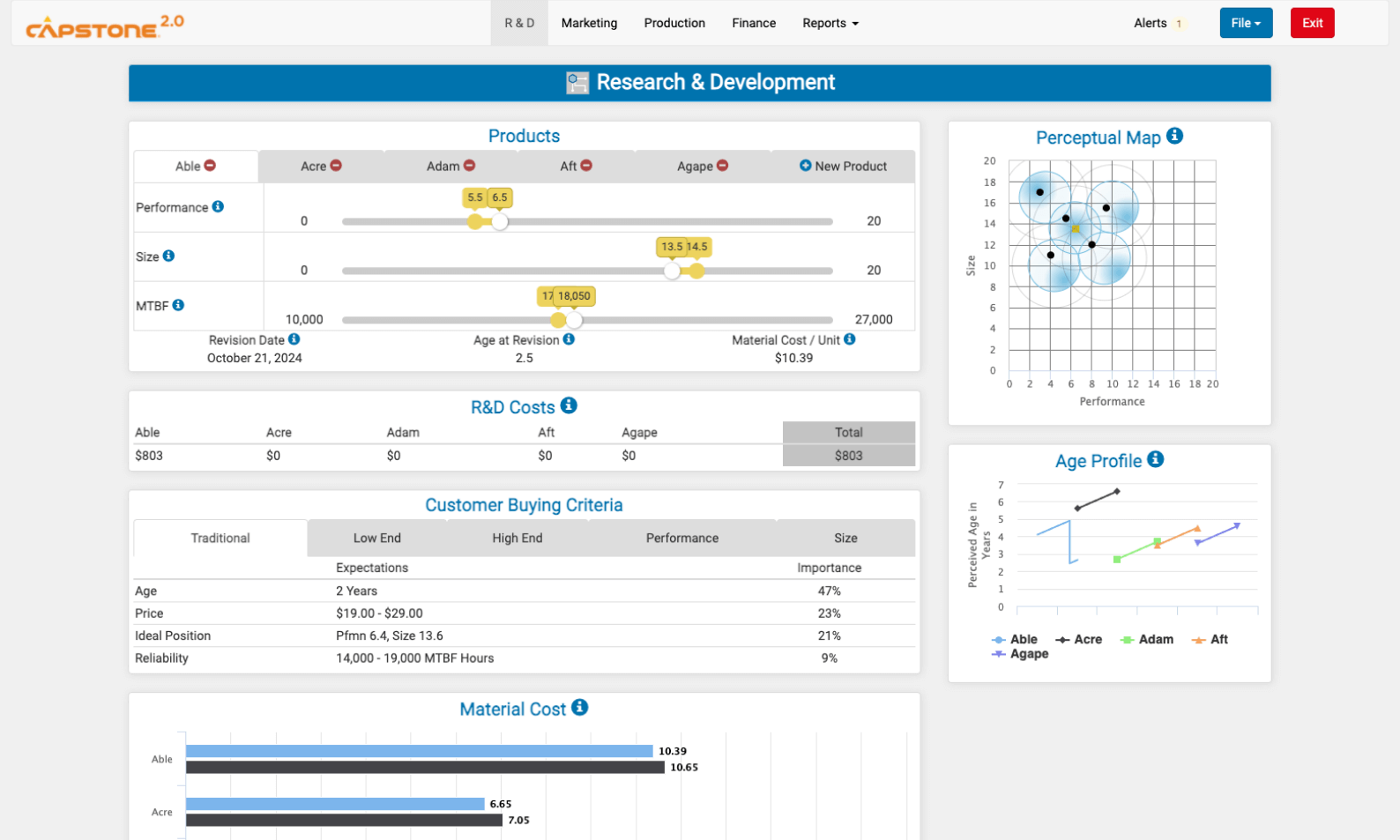
More than 2 million students have made that leap inside a Capsim simulation.
How it works
One company. One year at a time.
Each round is a year in the life of a company your learners run. They decide, the market responds, the results post, and they live with every call, round after round. That's the part a case or a lecture can't teach.
- 1
They decide
Pricing, capacity, R&D, financing, people, every function, in one connected set of calls.
- 2
The market responds
Competitors move, customers choose, demand shifts. No answer key, the outcome depends on everyone's calls.
- 3
The results post
Profit, market share, stock price. They see exactly what their decisions produced.
- 4
It carries forward
No reset. The plant they built and the debt they took are the position they start next year from.
↻ Repeat across rounds, each a year, and consequences compound. By the end, they've run years of a business and learned to think like a manager, not a major.
Why it works
Not a case study with a right answer
A case is solved and over. A simulation is a live business that pushes back, which is what turns knowledge into judgment.
In the classroom
Where students finally connect the pieces
Different courses run different builds. Three programs, the simulation each one chose, and what happened.

Dr. Hakim Meshreki starts first-year students on CapsimCore, running a whole business before their first internship. Enrollment climbed from 90 to 455.
Justin Carter runs North Alabama's Strategic Management capstone on Capstone, then closes the course with Comp-XM, one final read on what each student can do.
Rita Cossa runs CapsimCore across three online courses and 1,000+ students: eight rounds in four weeks, in every time zone.
“Finance affects marketing, which affects production and R&D. Students see that everything is interconnected. They learn you can’t work in silos — and that, to me, is the essence of strategy.”

“Simulations pretty much touch every single task characteristic. It’s really hard to cognitively offload a lot of this work — there are a lot of paths to success, open-ended and complex by design.”
Built to fit your course
One engine, configured to how you teach
Run it solo or in teams, online or in person, at any scale, tuned to the course you teach and wired into the systems you already run.
Configure the simulation
Solo, teams, 1 to 1,000+
Individuals on their own or teams running a company together, a single seminar or a multi-campus program, the same engine runs all of it.
Practice and competition modes
Let learners rehearse against the computer, then compete head-to-head when they're ready.
Adjustable conditions
Dial the market and difficulty to the level of the course, strategy fundamentals to MBA capstone.
Watch →Case modules
Drop a strategic threat or opportunity into the later rounds, an attractive new market, a cost shock, and force teams to rethink their strategy.
Watch →Score the company your way
Star ratings and weighted Success Measures on every simulation, plus the Balanced Scorecard on Capstone and CapsimCore. Graded the way your course needs.
Watch →Benchmark against the field
Percentile rankings compare every team to the national population of Capsim teams, and a Top Ten leaderboard recognizes the top performers, a yardstick that reaches past your own classroom.
Runs in your course
Running a simulation sounds like more prep and more grading. It's the reverse: setup, grading, and debrief prep are automated, and onboarding comes with your first course, so you're never setting it up alone. The logistics run themselves; the teaching stays yours.
AI Tutor
A simulation-trained assistant for your students and you, available around the clock. Tuned to the exact simulation you're running, so it guides decisions in context, without ever handing over the answer.
Watch →AI Debrief Tool
Upload a round's results and get a ready-to-run debrief in seconds, what happened, why, the standout and struggling teams, and the three things each team should fix next. Plus teaching notes and assignment ideas.
Learn more →LMS integration
Single sign-on and gradebook sync with Canvas, Blackboard, and every major LMS, students launch from your course, grades flow back on their own.
Built-in debrief reports
After each round, ready-made reports and visuals walk students through what just happened.
Watch →Custom report builder
Build the reports you need from participant activity and results, searchable, sortable, and exportable to Excel.
Watch →Turnkey eText bundles
Bundle the simulation with eTextbooks, presentations, and activities, everything for the course in one package.
Learn more →
Assurance of learning
The simulation scores the company. Put each student in front of the board for the evidence accreditors actually need:
- Comp-XMStudents run the same simulation solo, then answer to the board, questions that require analyzing competitors' performance, not just their own. Scored against the Big 7 learning goals.4–6 hrs
- CapsimInbox-XMPrepping for a shareholder meeting, students answer board members' emails about company performance, each working from an individualized report. Scored across seven subjects.1–2 hrs
Choose your simulation
The right fit for your course, from fundamentals to the capstone
Same connected business underneath, one learning model, sized and themed for where your course sits, from a first strategy course to the MBA capstone.
| Simulation | Level | Segments | Products | Global markets | Scoring | Best for |
|---|---|---|---|---|---|---|
| CapsimCoreFoundational, fully cross-functional▶Watch Walkthrough | Beginner | 2 | 1–4 | No | Stars, Success Measures, Balanced Scorecard | Strategy fundamentals |
| CapsimGlobalA domestic company goes multinational▶Watch Walkthrough | Intermediate | 2 | 1–4 | Yes | Stars, Success Measures | International strategy |
| CapsimOpsOperations in the spotlight▶Watch Walkthrough | Advanced | 2 | 1–4 | No | Stars, Success Measures | Operations management |
| CapstoneMost popularThe comprehensive flagship, our most-used simulation▶Watch Walkthrough | Advanced | 5 | 5–8 | No | Stars, Success Measures, Balanced ScorecardTriple-Bottom-Line ↓ | Advanced strategy & capstone |
Sustainability that reinforces the fundamentals
A triple-bottom-line mode, teams are scored equally on people, profit, and planet, with sustainability decisions woven through R&D, production, HR, and finance. It builds on the business model, rather than replacing it.
Not sure which fits? A demo walks you through it in 30 minutes.
Where it fits
Run it in a course, prove what they learned, or build it into leadership development
Teach with it
Bring the simulation into a course, capstone, strategy, or intro, with assurance-of-learning evidence built in.
Faculty & administrators Explore for higher ed → Prove the learningMeasure what they learned
The decisions students make running the simulation become validated, comparable evidence of learning, mapped to the outcomes you already report. It measures the judgment the simulation built, not separate material to memorize.
Assessments See how it’s measured → For corporate L&DDevelop leaders with it
The same engine, wrapped in a facilitated cohort experience and tuned to your strategy, the Leadership Accelerator.
Talent & leadership teams Explore the Accelerator →Questions instructors ask
Before you bring it to your course
What is a business simulation?
A business simulation is a digital environment where learners run a company, making real decisions on pricing, production, financing, and R&D, then living with the results across multiple rounds. Capsim's puts a whole connected business in their hands, so they build judgment by running it, not by reading a case.
How long does it take to run?
You set the pace. CapsimCore can run in as little as a day or stretch across a term; Capstone typically spans a full course over multiple rounds. Each round is a year in the company's life.
Online, in person, or hybrid?
All three. The simulation runs fully in the browser, so it works the same whether your course is in a classroom, fully online, or hybrid.
Does it work with our LMS?
Yes. Capsim integrates with Canvas, Blackboard, and the other major learning management systems, single sign-on so students launch straight from your course, and gradebook sync so scores flow back automatically.
How do students get access, and how does pricing work?
Flexibly. Students can buy access directly, like a course text, or order it through your campus bookstore. Prefer to cover it centrally? Your program can set up a site license. We'll help you choose whatever fits your course and your students.
Solo or teams, and how large can a class be?
Either. Students compete individually or run a company in teams, and it scales from a single seminar to 1,000+ learners across sections and campuses.
Will it work for non-business majors?
Yes. Instructors run Capsim from a first strategy course to the MBA capstone, including with humanities, engineering, and health students, the difficulty adjusts to the course, and the cross-functional view is exactly what non-majors need.
Can students just use AI to win?
No. Each team's position is the product of its own accumulated decisions, in a market that competing student teams keep moving, so there's no generic answer to look up, and even a good plan goes stale the moment competitors act.
How is it graded?
However you weight it: star ratings and Success Measures on every simulation, plus the Balanced Scorecard on Capstone and CapsimCore, these score the company's results, paired with individual assessment scores so grades reflect both the business and the student.
How do I measure individual learning for assurance of learning?
The simulation scores the company's results. To assess each student individually for assurance of learning, put them in front of the board. With Comp-XM, they run the same simulation solo, then answer the board's questions, which require analyzing competitors' annual reports, not just their own, scored against the Big 7 learning goals (4–6 hours). With CapsimInbox-XM, they prep for a shareholder meeting, answering board members' emails about the company's performance from an individualized report, scored across seven subjects: strategy, marketing, finance, accounting, human resources, operations, and sustainability (1–2 hours).
Backed by Capsim
You're never running it alone.
See a business simulation built around your course.
Book a 30-minute demo, bring the course you teach, and we'll show you the simulation mapped to it.
