
Behavioral Assessment
The inbox simulation that measures judgment, not recall.
Each person steps into a role and works a realistic inbox of competing demands, in any course or program, no business simulation required. Every decision they make is measured, so judgment becomes evidence you can compare across a class or a cohort.
See it run on a real scenario.
Trusted in university classrooms and Fortune 500 leadership programs.
“We're 12% short for Q3 and the board meets Friday. I need your call by end of day — what do we do?”
Three ways to get one
Off the shelf, built by you, or built with you.
Every version runs on the same validated engine, start in minutes or tailor it to your exact role and competencies.
Pick one from the library
Proven, ready-to-use inboxes across leadership, management, and core business concepts, live in minutes.
Author it, no code
If you can write an email, you can build an inbox simulation. Take real situations from your team, de-identify them, and create your own. Start free, and only pay when you deploy.
Start building free →Have Capsim build it
Our I-O psychologists and your subject-matter experts turn your real scenarios into a custom, validated assessment, mapped to your competencies, in weeks.
Talk to sales →Knowing vs doing
A test measures what they know. An inbox measures what they'd do.
A multiple-choice test or a case write-up captures what someone can recall. Neither shows what they'd actually do when the information is incomplete, the priorities compete, and the decision can't wait. An inbox drops them into that moment and measures the call they make.
overall
- Organizing
- Leading
- Problem-solving
- Communicating
✓Behavioral evidence, not a self-report
It's the difference between knowing the material and being ready for the job.
How it works
One role. One inbox. One decision at a time.
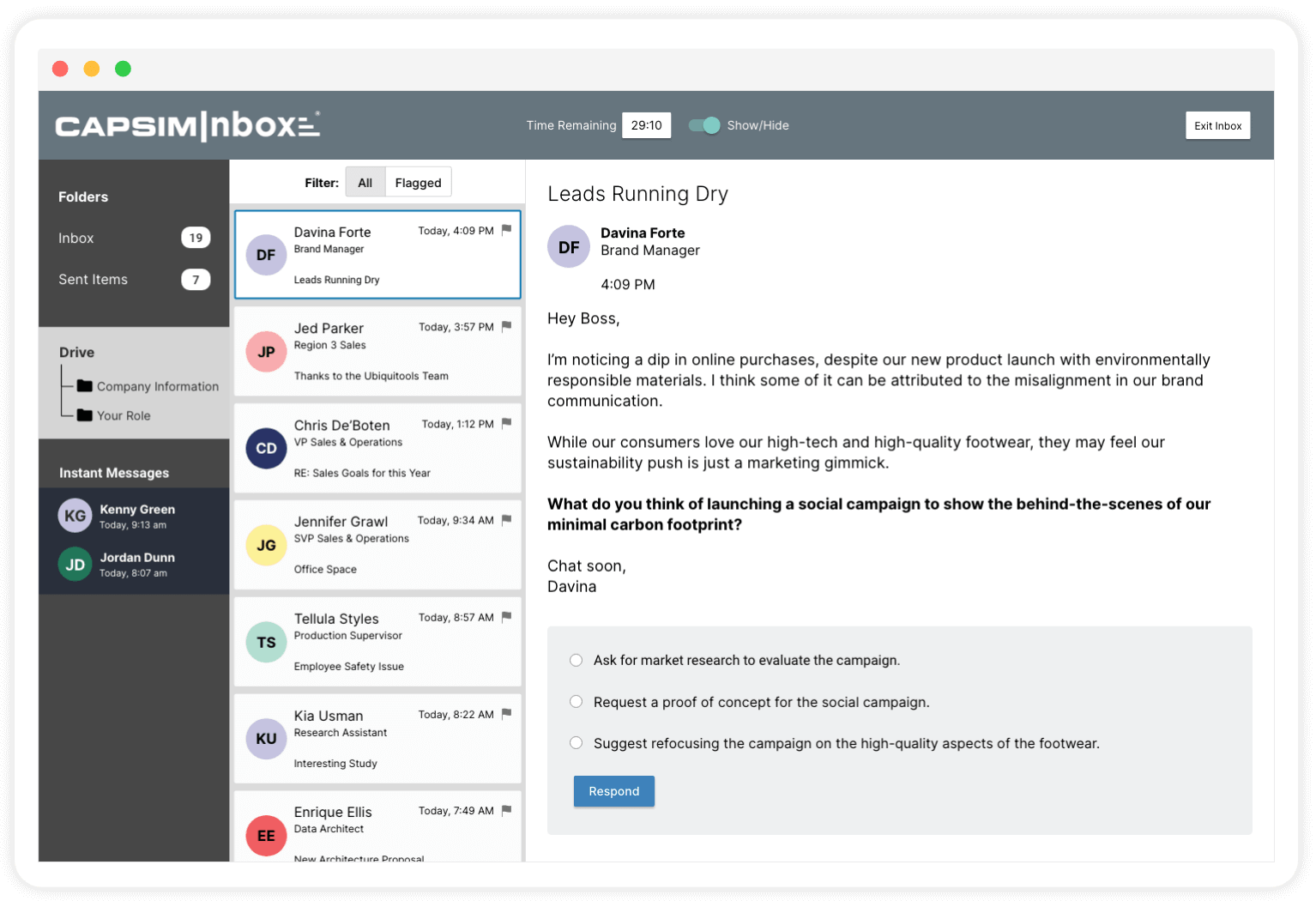
The participant steps into a role and works a realistic inbox, competing priorities, incomplete information, a clock. Every choice they make is measured. What you get back isn't a grade; it's a read on how they decide.
- 1
Step into a role
They become the manager, a brand lead, a department head, a director. The inbox is theirs now.
- 2
Work a real inbox
Emails, instant messages, and documents arrive, some urgent, some noise, none with a clean answer.
- 3
Make the call
For each situation, they choose how to respond: in context, under time, with trade-offs that don't resolve cleanly.
- 4
Every decision is scored
There's no right answer, responses rate from worse to best. And one call can lift some skills while costing others, the trade-off a real manager lives with.
✓ By the end, you don't have a test score. You have evidence of how they'd handle the job.
Why it works
Recognition isn't judgment.
A test rewards recognizing the right answer. Judgment is what's left when there isn't one: incomplete information, competing priorities, consequences that carry forward. An inbox puts people in exactly that, decision after decision.
Every option has a cost
Incomplete information, competing stakeholders, trade-offs that don't resolve cleanly. There's no key, only a better or worse call.
One choice moves the rest
Branching logic means a decision reshapes what hits the inbox next, and a single call can move several skills at once, up and down.
It all goes on the record
Earlier calls set up later ones, and none of them reset. The path they choose is the path they're measured on.
Every call is recorded and scored, so you get evidence of judgment, not a proxy for it.
The evidence
Measurement you can defend.
CapsimInbox is a situational judgment assessment, built and validated by industrial-organizational psychologists, and used to make real decisions in companies and classrooms.
Read the technical synopsis (PDF) →
“It's the ultimate validation of your training efforts — to be able to say, here's where we were, and here's where we are now. Most of our training is technical, where the change is easy to see. With CapsimInbox, you can see the results even when they're not.”
Microsoft measured roughly 60 of its highest-ranking engineers before and after the program, across 14 countries, and several were promoted into people-manager roles.
Used by teams at Microsoft and Caterpillar, and in classrooms at Michigan State and the University of Florida.
For the participant
Everyone finishes with a report, and a plan.
The moment they're done, each participant gets an individualized read on how they actually decided, their judgment in context, the blind spots they didn't see, and a guided plan to close them.
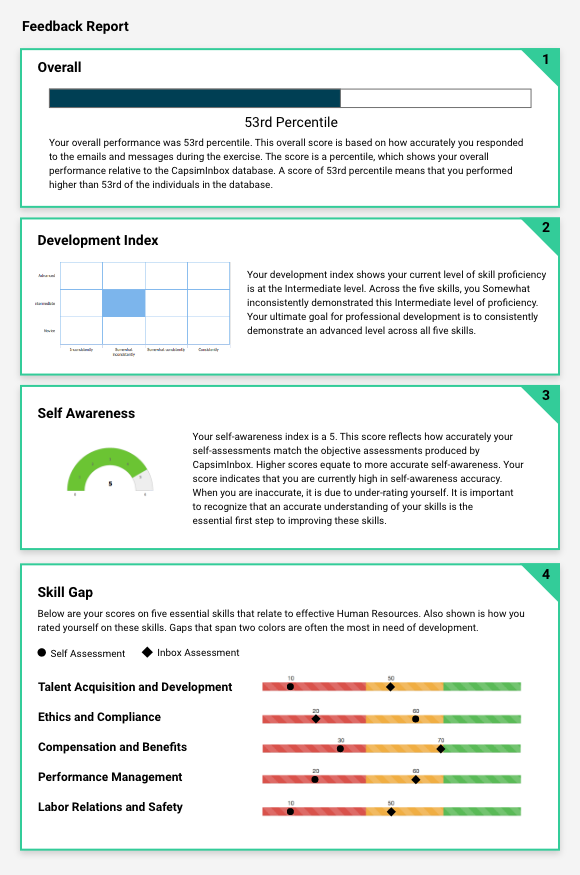
- Overall percentileWhere they rank against the full population of participants, or just your org.
- Development indexHow proficient their decisions were, and how consistently across the scenario.
- Self-awareness gaugeTheir own self-rating, set against how they actually performed.
- Skill-gap analysisStrengths and the specific skills to develop, self-rating versus actual.
- IDP BuilderA guided development plan with concrete tactics to improve their weakest areas.
For the instructor
Evidence of judgment, at every level.
Every decision becomes evidence you can act on, scored against your own competency framework and benchmarked against the field, from one participant up to the whole population. Exportable to your LMS in a click.
Start with one person
Every participant gets a full result, scored skill by skill, with the blind spots they didn't see.
- Overall percentile and development index
- Strengths and gaps, by skill
- Self-awareness: their rating vs reality
- 85Organizing
- 80Leading
- 72Problem-solving
- 78Communicating
- 83Initiating
Roll up to the cohort
Every participant in one view, the class average, and exactly where each person lands.
- Class-average percentile and skill scores
- Every participant ranked, side by side
- Spot the cohort's collective gaps
| Participant | Overall | Self-aware | Development |
|---|---|---|---|
| Rivera, A. | 82 | 4 | Advanced |
| Chen, J. | 74 | 5 | Advanced |
| Patel, S. | 69 | 3 | Intermediate |
| Okafor, M. | 61 | 4 | Intermediate |
| Brazier, J. | 54 | 2 | Developing |
…up to the whole population
See how your cohort stacks up against every participant who's taken it, scored on a validated, national norm.
- Benchmarked against the national population
- Percentile rank at a glance
- Validated, normed scoring you can defend
Outperforms 65% of all participants nationwide.
Where it fits
Wherever you develop people.
Use it in your courses
Check core concepts in gateway courses, measure judgment in upper-level ones, and gather the assurance-of-learning evidence accreditors ask for.
Faculty & administrators Explore for higher ed → For corporate L&DAssess & develop your leaders
Measure leadership and role-specific skills, surface high-potentials, screen candidates, and prove training impact.
Talent & leadership teams Explore leadership assessment →FAQ
Inbox simulations, answered.
What is an inbox simulation?
An inbox simulation drops a participant into a role and a realistic email inbox, messages from colleagues, the board, and customers, and asks how they'd respond. It's a modern, software-scaled take on the in-basket exercises long used in assessment centers: a day-in-the-life that measures the decisions someone makes, not what they can recall.
How is it scored?
There's no single right answer. Subject-matter experts rate each possible response from worse to best (the critical-incident method), and a single decision can raise some skills while lowering others, the same trade-offs a real role carries. Every choice is scored against that expert standard and ranked against the population. It's auto-scored for consistency at scale, not AI-scored.
Is CapsimInbox validated?
Yes. CapsimInbox is a situational judgment assessment built by four PhD industrial-organizational psychologists. It predicts on-the-job performance at r=.43, above the assessment-center benchmark, with test-retest reliability of .86 to .93. Read the technical synopsis (PDF) →
How long does an inbox simulation take?
Most ready-made inboxes run 30 to 60 minutes, across roughly 20 to 30 scenarios. Short role-preview versions can be as little as 5 to 10 minutes.
Where does it fit in a program, and is it academic or corporate?
Both, and across the curriculum. Faculty use community-created inboxes that span the whole program, gateway inboxes for core concepts in intro courses, and targeted judgment inboxes, like ethical decision-making, that upper-level and capstone faculty add to their courses. For a full strategy capstone, the team business simulation is the run-a-company experience, and CapsimInbox-XM pairs with it to measure each student individually for assurance of learning. Companies use it to assess leadership and role-specific skills, screen candidates, and prove training impact.
Can we customize it, or build our own?
Yes. Start with a ready-made inbox from the library, build your own in the no-code authoring platform (if you can write an email, you can build one), or have Capsim build a custom version with your subject-matter experts.
Does it work with our LMS?
Yes. Single sign-on and data flow through SCORM and xAPI, with Canvas, Cornerstone, Moodle and other major systems. It's available in any language.
What's the difference between CapsimInbox and CapsimInbox-XM?
CapsimInbox is the inbox-assessment platform on this page. CapsimInbox-XM is the assurance-of-learning version that pairs with the team business simulations to measure each student individually.
Enterprise-ready
Built to meet your standards.
See what your people would actually do.
Book a 30-minute demo, bring a role you teach or hire for, and we'll show you the inbox that measures it.